Let's be real for a moment—a bad cup of coffee can ruin your entire morning. The good news is that the secret to a consistently amazing brew isn't some mystical art form. It's a simple, reliable formula known as the coffee golden ratio, a starting point that typically falls somewhere between a 1:16 to 1:18 ratio of coffee to water.
The Foundation of Great Coffee

Think of the golden ratio as the North Star for your daily brew. It’s a standardized guideline for the ideal balance between coffee grounds and water, measured by weight, not scoops. Following this single principle is probably the most significant change you can make to level up your coffee from just "okay" to something truly special.
So, why all the fuss about a ratio? It all boils down to extraction—the scientific term for dissolving all those delicious, flavorful compounds from the coffee grounds into your water. When this balance is off, you get one of two all-too-common results. Too much coffee (or not enough water) makes for an overly strong, bitter, and harsh cup. On the flip side, too little coffee (or too much water) leaves you with a brew that’s weak, watery, and even a bit sour.
Finding Your Perfect Balance
The golden ratio gives you a reliable starting point to avoid those bad cups. While you can (and should!) tweak it to your personal taste, the industry standard is the perfect place to begin. The Specialty Coffee Association (SCA) has long championed this approach as the benchmark for achieving the best possible strength and flavor. This standard really took hold in the 2010s, cementing a precise 1:18 coffee-to-water ratio by weight—that’s about 55 grams of coffee per 1 liter of water—which has guided how baristas and home brewers alike achieve a perfectly balanced extraction. You can discover more insights about these brewing benchmarks and how they've shaped modern coffee.
Think of the coffee golden ratio like a recipe for baking a cake. You wouldn't just guess how much flour to throw in the bowl and hope for the best. Brewing coffee is the same; it's all about creating a consistent, delicious result every single time.
By embracing this simple formula, you stop guessing and start taking control of your coffee. This guide will walk you through everything you need to know, from the basic science to applying the ratio to your go-to brewing method. It’s far easier than it sounds and is the foundation for every great cup you'll make from here on out.
Once you master this concept, you’ll be able to:
- Brew with Confidence: No more guesswork. You’ll know that every cup is going to be well-balanced from the start.
- Diagnose Your Brew: Finally understand why your coffee tastes a certain way and know exactly how to adjust it.
- Save Money: Stop wasting those beautiful, expensive beans on bad brews and get the most flavor out of every single gram.
Ultimately, the goal is to give you the know-how to stop hoping for good coffee and start making it.
The Science Behind Flavor Extraction and Brew Strength
Have you ever brewed a cup of coffee that tasted absolutely electric, full of life and flavor, only to have the next one fall completely flat? It’s not a fluke. There’s a science to it, and it all comes down to two key ideas: extraction and strength. Getting a handle on these concepts is the first step to truly understanding why the golden ratio is so effective.
Think about brewing coffee as a simple act of dissolving flavor. When hot water hits your coffee grounds, it starts pulling out all the soluble good stuff. This process is called extraction.
But here's the catch: not everything dissolves at once. The first flavors to come out are the bright, fruity acids. Next, you get the sweet, rounded notes like chocolate and caramel. If you let it go too long, you start to pull out the heavy, bitter compounds that can ruin a cup.
Finding the Flavor Sweet Spot
This timing is everything. It's why a few seconds can make or break a brew and leads to the two most common problems in coffee making.
- Under-extraction: This is what happens when you don't extract enough flavor. Your coffee tastes sour, grassy, or strangely salty because you've only pulled out those initial acidic compounds. It’s like dunking a tea bag in water for five seconds—it’s just weak and unsatisfying.
- Over-extraction: Go too far, and you've got the opposite problem. You've pulled too much from the grounds, including all the bitter, harsh flavors. This creates an astringent, drying sensation in your mouth that completely smothers any of the coffee's natural sweetness.
The goal is to land right in that extraction sweet spot. For decades, coffee professionals have agreed this is when you've dissolved between 18% and 22% of the coffee bean's mass into the water. This is where you find that perfect harmony of acidity, sweetness, and body.
Connecting Strength and Extraction
So, extraction is about which flavors you pull from the coffee. Strength, on the other hand, is about how much of that flavor is in the final cup. It’s a measure of concentration, often referred to as Total Dissolved Solids (TDS). A "strong" coffee has a high concentration of coffee solids, while a "weak" one feels thin and watery.
It's entirely possible to have a properly extracted coffee that’s weak, or an over-extracted one that’s also weak. This is where the golden ratio comes in—it’s the framework that helps you dial in both ideal extraction and your desired strength at the same time.
The coffee golden ratio is your starting point. It creates the ideal conditions for water to flow through the grounds, extract the right amount of flavor, and produce a brew that is both well-extracted and enjoyably strong.
This celebrated ratio isn't new; its roots stretch back to 17th-century Dutch trade and were later refined by the Specialty Coffee Association (SCA) to target a brew strength of 1.15% to 1.45% TDS. This simple formula is a cornerstone of a global market set to grow from $138.37 billion in 2026 to over $174.25 billion by 2030.
By starting with a ratio around 1:17, you put yourself in the best position to hit that coveted flavor target. Of course, your brew time, grind size, and water are just as important—especially finding the correct temperature for coffee.
Golden Ratio Starting Points For Popular Brew Methods
Think of the "golden ratio" as a beautifully drawn map—it shows you the destination, but the best route often has a few scenic detours depending on your vehicle. In coffee, your "vehicle" is your brewing method. Each one interacts with the coffee grounds and water in its own unique way, so small adjustments are the key to unlocking its full potential.
This is where the real fun begins. Let's look at some clear, actionable starting ratios for your favorite brewers. We’ll show you how to tweak the golden ratio to get consistently amazing coffee, whether you have five minutes or fifteen to spare.
To make things even easier, here’s a quick reference table with my go-to starting points for the most common brew methods. Use this as your launchpad, and don't be afraid to adjust based on your own taste.
Recommended Coffee To Water Ratios By Brew Method
| Brew Method | Recommended Ratio (Coffee:Water) | Grams of Coffee per 300ml Water | Flavor Profile Goal |
|---|---|---|---|
| Pour Over | 1:16 | 19g | Clean, nuanced, bright |
| French Press | 1:14 | 21g | Rich, full-bodied, robust |
| AeroPress | 1:16 (or 1:5 for concentrate) | 19g (or 60g for concentrate) | Versatile, clean, or espresso-like |
| Cold Brew | 1:8 | 38g (for concentrate) | Smooth, low-acidity, syrupy |
| Instant Coffee | 1:18 | 16.5g | Quick, balanced, consistent |
These ratios are the foundation of a great brew. Once you’ve dialed in your favorite, you'll be able to repeat that perfect cup every single time.
Pour Over Coffee Ratio
For percolation brewers like the V60, Kalita Wave, and other drippers, a 1:16 ratio is a phenomenal starting point. This means for every 1 gram of coffee, you'll use 16 grams of water. It's the sweet spot for creating a clean, nuanced cup where all those delicate floral and fruity notes can really sing.
To put that into practice, a standard 12-ounce mug (which holds about 340ml) would call for roughly 21 grams of coffee and 336 grams of water. The controlled flow of a pour over gives you incredible command over extraction, and this ratio provides just enough contact time to pull out the good stuff without veering into bitterness.
French Press And Immersion Ratio
Immersion methods are a different beast entirely. Since the coffee grounds are steeping directly in water for the whole brew, you need to adjust your approach. For something like a French Press, the constant contact often demands a slightly stronger, more concentrated ratio to get that classic full-bodied and robust profile.
I always start with a 1:14 ratio for French Press. This richer mixture is what produces that heavy, satisfying texture we all love. If you're using a common 34-ounce (1-liter) press, this works out to about 70 grams of coarse-ground coffee to 980 grams of water. The stronger ratio ensures the flavor is bold enough to stand up to the unfiltered nature of the brew.
The bottom line is this: full immersion methods generally need a more concentrated ratio to build a rich, powerful flavor. On the other hand, percolation methods like pour over shine with a slightly wider ratio that highlights clarity and complexity.
AeroPress And Cold Brew Ratios
The AeroPress is the chameleon of the coffee world—it can do just about anything. If you want a standard, drip-style cup, you can stick close to that classic 1:16 golden ratio. But where it really gets interesting is when you make a concentrated "shot" first.
- For an AeroPress concentrate: Start with a tight 1:5 ratio (think 15g of coffee to 75g of water). This creates a strong, espresso-like shot that you can then dilute with hot water to your preferred strength.
- For Cold Brew concentrate: Since you're extracting without heat, you need a much higher concentration of coffee. A 1:8 ratio is a great starting point, steeped for anywhere from 12 to 24 hours. You'll then dilute this powerful concentrate with water or milk, usually at a 1:1 or 1:2 ratio, to serve.
If you're curious to dive deeper into these different styles, check out our complete guide to the best coffee brewing methods.
Cartograph Coffee: The Instant Golden Ratio
High-quality instant coffee is the ultimate shortcut to a great cup, no compromises needed. For anyone on the go, knowing the right ratio means you can have perfect coffee anywhere. The recipe is beautifully simple: just dissolve 5.5 grams of premium organic instant coffee in 100ml of hot water. That’s it.
This approach is more relevant than ever. Recent data shows 73% of Americans drink coffee daily, and with 45% choosing specialty coffee in the last day alone—an 80% increase since 2011—the demand for quality is clear. A precise recipe ensures you’re getting a balanced, flavorful brew that honors the quality of the coffee, whether you're at your desk or on top of a mountain.
How to Measure and Brew with Precision
Alright, enough with the theory—let's get our hands dirty and actually brew some coffee. Moving away from inconsistent scoops and toward precise measurements is the single biggest leap you can take to make cafe-quality coffee in your own kitchen. This isn’t about becoming a scientist; it's about embracing a simple, rewarding ritual that guarantees a fantastic cup, every single time.
Your most important tool? A digital kitchen scale. It's that simple. Why? Because coffee beans are all different shapes and sizes. A scoop of small, dense beans from Ethiopia will weigh a lot more than a scoop of larger, lighter beans from Peru. A scale cuts through all that guesswork and gives you true consistency.
Your First Golden Ratio Brew, Step by Step
Let’s walk through it. This process might seem a little fussy at first, but I promise it quickly becomes second nature. This basic method is your foundation for nearly any brew style, from a simple pour-over to a French press.
-
Pick Your Ratio: Let's start with the classic 1:16 ratio. It's a fantastic, well-rounded starting point that flatters most coffees and brewers. This just means for every 1 gram of coffee, you'll use 16 grams (which is the same as 16 milliliters) of water.
-
Weigh Your Coffee: Place a small bowl or your grinder's hopper on your scale and hit the "tare" or "zero" button to reset it. Now, weigh out your whole beans. If you're aiming for a standard 12-ounce mug (that's about 340ml), you'll want around 21 grams of coffee.
-
Grind Fresh: Grind those beans you just weighed. Make sure the grind size is right for your brewer—think coarse for a French press or medium for a drip machine. A consistent grind is key to getting a balanced extraction.
-
Measure Your Water: Here's a pro-tip that makes life easier. Put your entire brew setup (like your pour-over cone sitting on your mug) onto the scale and tare it again. This lets you measure the water as you pour, so you don't have to do any math on the fly.
-
Start Brewing: Begin pouring hot water over your coffee grounds, watching the number on the scale climb. For our 21-gram example, you'll pour until the scale hits 336 grams. That's it! You've just brewed a perfect golden ratio cup.
The Real-World Payoff of Precision
Getting this right isn't just about nailing the flavor. With global coffee prices jumping nearly 90% in just a couple of years, being efficient with your beans matters. Using a smart ratio like 1:18 means you're getting the absolute most out of every bag.
There are health benefits, too. For families who care about wellness, brewing accurately with water at the right temperature (around 92-96°C or 198-205°F) can pull out 20-30% more of the beneficial antioxidants locked inside the coffee. This idea of quick, precise, high-quality brewing is exactly what drives products like Cartograph's organic instants, which are designed to deliver a perfect cup without the fuss.
A scale doesn’t make coffee more complicated; it makes it simpler. It replaces guessing with knowing, giving you the confidence that every adjustment you make is intentional and repeatable.
Knowing the right coffee-to-water ratio is the foundation of great coffee, and a clear breakdown of how much coffee grounds per cup of water you need is the perfect starting point for dialing in your preferred strength. From here, you can move from just following recipes to truly creating your own. If you want to dive deeper, our guide on how many grams of coffee per cup can help fine-tune for different tastes. By weighing your ingredients, you take back control.
Dialing It In: How to Calibrate Your Brew to Taste
Think of the golden ratio as your starting point on a map. It gets you to the right city, but now it’s time to find your favorite coffee shop on that perfect little side street. Your own palate is the ultimate guide, and learning to listen to it is what really elevates your coffee game. This is where you move beyond just following a recipe and start crafting a cup that’s perfect for you.
The idea is simple: if your coffee tastes a certain way, you just need to make a specific adjustment. Once you get the hang of connecting a flavor to a fix, you’ll have total control over your brew. The trick is to start from a consistent baseline—that 1:16 ratio is perfect for this—and then only change one thing at a time.
This simple, three-step process is the foundation for every great cup of coffee.
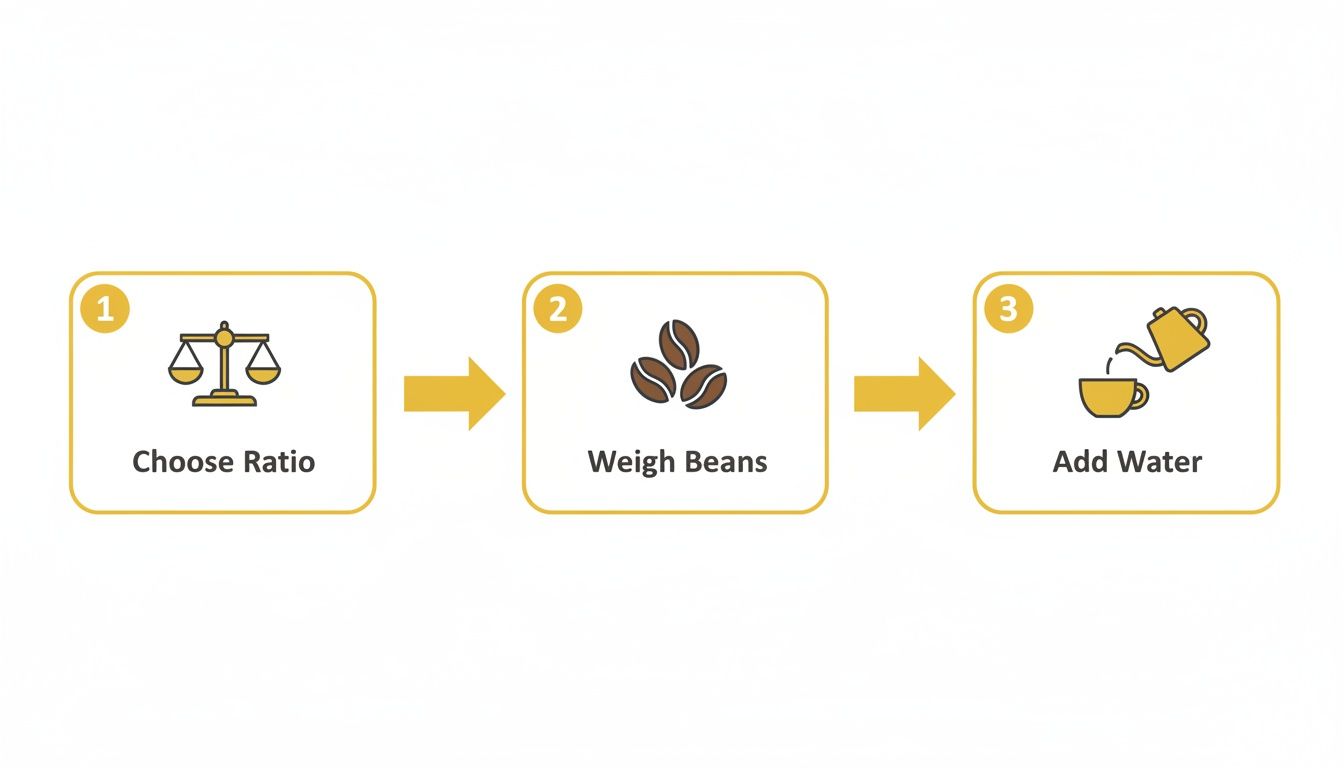
It all comes down to choosing your ratio, weighing your coffee, and adding the right amount of water. From there, you can start making small tweaks to get it just right.
How to Read Your Coffee and Make Adjustments
So, your coffee isn't quite hitting the mark. Let's figure out what your taste buds are telling you and how to respond.
-
If it tastes sour, thin, or kind of grassy: You’re tasting under-extraction. The water just didn't have enough contact time to pull out all the good stuff, leaving you with the sour compounds that extract first.
- The Fix: Grind your coffee finer. This creates more surface area, giving the water more to work with and helping it extract all those sweet, balanced flavors more easily.
-
If it tastes bitter, harsh, or unpleasantly dry: That’s a clear sign of over-extraction. The water hung around for too long and started pulling out the bitter compounds you want to leave behind in the grounds.
- The Fix: Grind your coffee coarser. This reduces the surface area, slowing down the extraction process just enough to keep those harsh flavors out of your final cup.
Your grind setting is the main dial you'll use for taste. It’s like the focus knob on a camera—tiny adjustments can bring the entire picture into sharp, clear detail. Mastering your grind is the most powerful tool you have for perfecting flavor.
Using the Ratio Itself for Fine-Tuning
While grind size is your number one tool, you can also tweak the coffee-to-water ratio to adjust the strength and body. This is more about personal preference than fixing a flawed brew.
- Want a stronger, bolder cup? Use a little less water. Try shifting from a 1:16 ratio to a 1:15 or even 1:14. This results in a more concentrated brew with a heavier, more syrupy mouthfeel.
- Prefer a lighter, more delicate brew? Use a little more water. Moving to a 1:17 or 1:18 ratio will lighten the body, reduce intensity, and allow the coffee’s more subtle, nuanced notes to shine through.
This level of precision is about more than just taste. For many, it's about getting the most out of their coffee, from maximizing beneficial compounds like chlorogenic acids to simply knowing exactly what’s in their cup. This desire for quality and consistency is what's driving the ready-to-drink coffee market's impressive 6.1% annual growth.
It’s a principle that connects a home brewer to the global industry, which produces 178.8 million bags of coffee worldwide. Brands like Cartograph Coffee build their entire philosophy on this, ensuring that same commitment to quality is present in every jar. You can find more on current coffee market trends and consumer insights to see just how much quality is shaping what we drink.
Once you learn to interpret what your cup is telling you, you're no longer just making coffee—you're crafting it with intention.
Beyond the Ratio: Your Next Steps in Brewing
You've done it. You’ve locked in the single most important part of brewing consistently great coffee: the coffee golden ratio. Nailing your ratio gives you a reliable foundation, a repeatable recipe you can count on every single time. But that's just the beginning of the adventure.
Think of the golden ratio as your trusty home base. It's the starting point you can always return to for a solid, delicious cup. Now, it's time to venture out and see what other variables can turn that good cup into a truly exceptional one.
The Other Pillars of a Great Brew
Your ratio is the map, but a few other key elements will determine what you discover on your flavor journey. Once you have your coffee-to-water ratio down, these are the next levers you can pull to refine your brew.
-
Bean Quality and Freshness: This is non-negotiable. The most precise technique in the world can't rescue stale or poorly grown beans. The coffee's origin, how it was roasted, and how recently it left the roaster all define the absolute flavor potential in your cup.
-
Water Purity: It might sound obvious, but since coffee is over 98% water, the quality of your H2O has a massive impact. Filtered water, free from chlorine or other funky tastes, provides a clean canvas that lets the coffee’s delicate notes shine through.
-
Grind Consistency: A uniform grind is the secret to a balanced extraction. If your grinder produces a mix of fine dust and coarse boulders, the small particles will over-extract (tasting bitter) while the large ones under-extract (tasting sour). The result is a muddled, disappointing cup.
Your Head Start on Flavor
This is exactly why starting with the right ingredients gives you such a massive advantage. At Cartograph Coffee, we've built our entire mission around sourcing incredible, organic coffee that always delivers on flavor. When you brew with our beans, you’ve already checked off that first, most critical pillar.
We believe great coffee should be accessible, honest, and consistently delicious. By handling the meticulous sourcing ourselves, we give you a head start so you can focus on the pure joy of brewing.
Your coffee journey is ultimately a personal one. The golden ratio is your guide, but your own palate is the final compass. We hope you'll keep exploring, tweaking, and tasting. There’s always a better, more flavorful cup out there waiting to be discovered.
Happy brewing
Frequently Asked Questions About the Golden Ratio
Even with a good grasp of the golden ratio, a few common questions always seem to pop up, especially when you're dialing in your brew. Let's tackle them head-on to clear up any lingering confusion and get you back to making great coffee.
Think of this as a quick chat to cover those last few "what ifs."
Can I Use Scoops Instead of a Scale to Measure Coffee?
You can, but if you're chasing that perfect, repeatable cup, a scale is your best friend. The problem with scoops is that coffee beans aren't uniform. A scoop of a light, dense Kenyan bean will weigh more than the exact same scoop of a dark, oily Sumatran bean. That inconsistency is the enemy of good coffee.
A digital scale takes all the guesswork out of the equation. It's a small investment that pays off big time by ensuring you’re using the exact same amount of coffee and water every single time. That’s the real secret to consistently delicious results.
Does the Golden Ratio Apply to Espresso?
Nope, espresso plays by a completely different set of rules. It’s a game of high pressure and high concentration, using a much tighter ratio that usually lands somewhere between 1:1 and 1:3 (coffee to water). This is what creates that intense, syrupy shot we all know and love.
The golden ratio, with its classic 1:15 to 1:18 range, is the benchmark for filter coffee—think pour over, drip machines, French press, and AeroPress.
A good way to think about it: the golden ratio is like a leisurely stroll, letting you take in all the scenery. An espresso ratio is an all-out sprint. Both are valid, but the experience and intensity are worlds apart.
What If I Like My Coffee Stronger Than the Golden Ratio?
Then you should absolutely make it stronger! The golden ratio is a fantastic starting point for a balanced cup, not a non-negotiable law. Its real purpose is to get you into the ballpark of proper extraction.
If you find yourself consistently wanting a bolder, more powerful brew, just tweak the ratio. Try moving from 1:16 down to a 1:15 or even 1:14 ratio to increase the concentration. At the end of the day, the best recipe is the one that tastes best to you.
How Does Water Temperature Affect My Brew?
Water temperature is a huge factor, directly controlling how quickly and effectively flavors are extracted from your coffee grounds. For the best results, you want your water between 195-205°F (90-96°C). An easy rule of thumb is to use water just off the boil.
If your water is too cool, you'll get a sour, weak, and underdeveloped coffee (under-extraction). If your water is scorching hot, you'll pull out all sorts of harsh and bitter flavors, making the coffee unpleasant (over-extraction).
Ready to put the golden ratio to the test with coffee that’s as convenient as it is delicious? Cartograph Coffee offers premium organic instant coffee designed for a perfect cup, every time. Discover the difference quality makes at cartographcoffee.com.